
Published:
March 18, 2026
Author:
Ross Kenyon
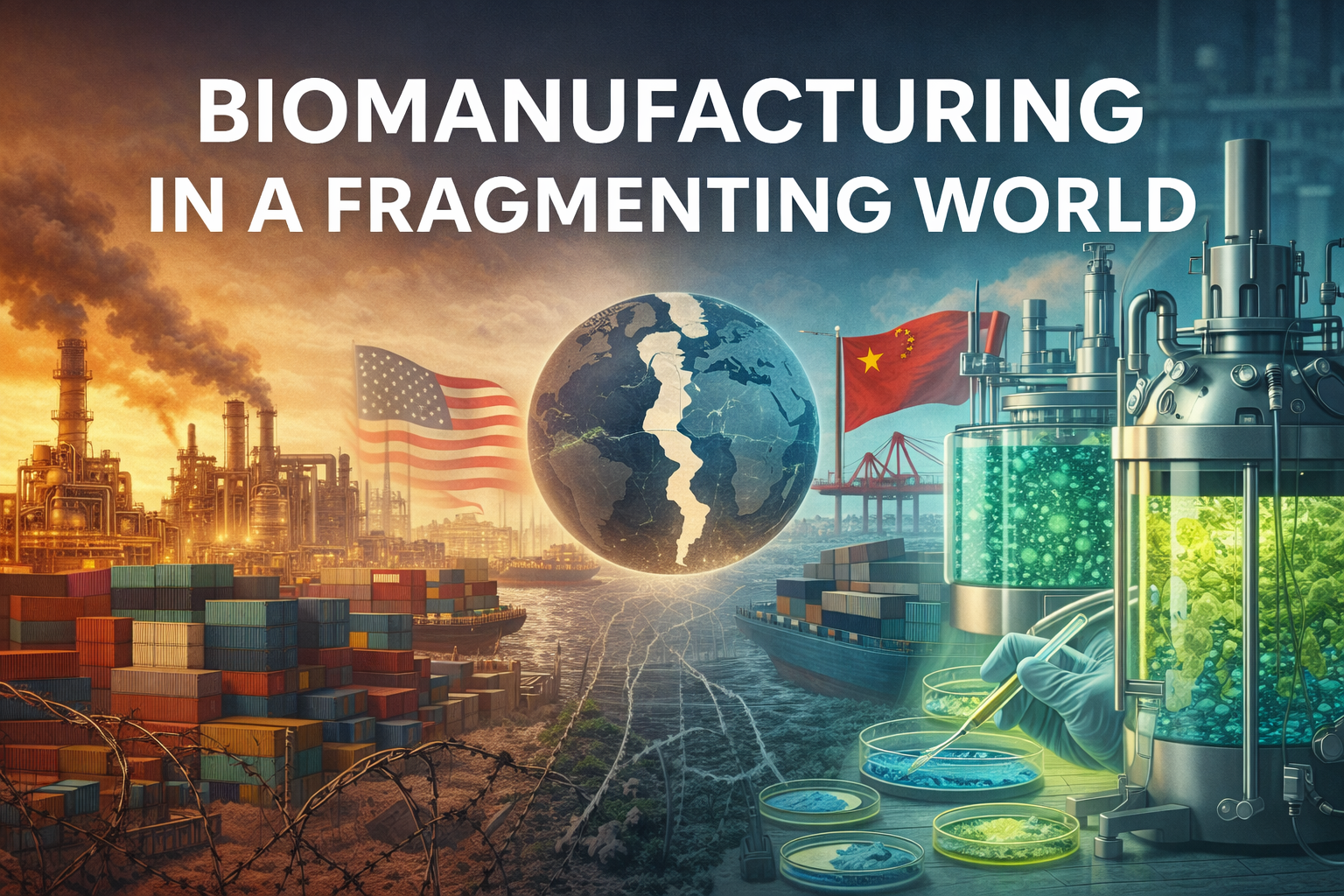
For the last few decades, global manufacturing has been optimized for a world that no longer exists.
That world assumed cheap energy, stable geopolitics, lightly regulated chemicals, and long, fragile supply chains stretching across continents. It assumed efficiency mattered more than resilience, and that risk could always be externalized to the environment, to public health, or to somewhere far away.
That set of assumptions is breaking down. And in that shift, biomanufacturing is becoming not just viable, but inevitable.
COVID was a stress test most systems failed. Entire industries discovered that critical inputs—chemicals, nutrients, feedstocks, specialty materials—were sourced from a small number of geographies, often with little redundancy and high geopolitical risk.
Since then, the world has moved further toward protectionism, reshoring, and economic autarky. Governments across the political spectrum are rethinking what must be made domestically: food, medicine, industrial inputs, strategic materials. Supply chains are no longer viewed as neutral infrastructure; they’re now political assets and liabilities.
In that environment, manufacturing paradigms that depend on centralized petrochemical supply chains, high-temperature processes, and globally distributed inputs look increasingly brittle.
Biology offers a different model.
Conventional chemical manufacturing is incredibly powerful… and incredibly constrained. It often requires:
As electricity prices rise, geopolitical risk increases, and bipartisan scrutiny around health and environmental exposure grows, these constraints become more expensive to manage. The “green premium” problem, where sustainability costs more, becomes untenable as energy prices rise and supply chains fragment.
At the same time, concerns about toxicity are no longer niche or partisan. PFAS, pesticide exposure, and petrochemical residues are now mainstream issues. Even as parts of the political system push deregulation, there is growing bipartisan discomfort with manufacturing processes that are clearly misaligned with human health.
The result is not a clean policy story, but an unstable one. Instability favors new approaches.
Biomanufacturing flips many of these constraints on their head.
Instead of extreme heat and pressure, it uses ambient conditions. Instead of complex synthetic pathways, it relies on biological systems that have already been optimized by evolution. Instead of centralized, capital-heavy facilities, it can support more modular, distributed production.
Crucially, biology doesn’t just promise “cleaner” manufacturing — it can be cheaper:
In a world where energy is no longer free, supply chains are political, and toxicity matters, biology isn’t a moral choice. It’s a pragmatic and economic one.

One company we’ve invested in, Erg Bio, illustrates this shift well.
Erg Bio converts diverse waste biomass into cost-competitive, net-zero sugars and sustainable aviation fuel using a proprietary biological platform that processes over 30 feedstock types. Their production costs approach parity with conventional jet fuel and undercut corn-derived sugar by more than 40%. By sidestepping first-generation feedstocks like corn and sugarcane, they avoid competing with food supply chains entirely while enabling production sited near local waste sources rather than tied to centralized petrochemical infrastructure.
What’s compelling isn’t just the sustainability angle. It’s that biology allows them to sidestep many of the structural risks baked into legacy manufacturing. Lower energy intensity, fewer inputs, and the ability to produce closer to end markets all matter more in today’s political and economic climate than they did even a decade ago.
Erg Bio is not alone. Across materials, chemicals, agriculture, and food systems, we’re seeing companies use biology to:
In many of these markets, the question is no longer if biology works, but where it creates the biggest strategic advantage. The most successful companies tend to focus less on climate narratives and more on fundamentals: cost, resilience, and scalability in a changing world.
The case for biomanufacturing does not depend on any single political outcome.
If global trade fragments further, biology wins because it enables localized production from locally available feedstocks. If trade stabilizes, biology still wins because it produces at lower cost with fewer processing steps and less energy.
If regulation tightens around petrochemicals, biology wins because it avoids the toxicity problem entirely. If regulation loosens, biology still wins because the unit economics are already competitive without regulatory tailwinds.
We invest in biomanufacturing not because we are predicting fragmentation, but because the companies we back are building processes that outperform legacy chemistry under virtually any scenario.
If you’re building in biomanufacturing, especially in materials, chemicals, or industrial inputs, we’d love to talk. We’re spending time here because we think the next generation of resilient manufacturing will look very different from the last.
And if this line of thinking resonates, it connects closely to how we think about adaptation and resilience more broadly.
.jpeg)
Ross Kenyon is a Climatetech Executive specializing in carbon removal. He co-founded Nori in 2017, a pioneering carbon removal marketplace, and hosts the "Reversing Climate Change" podcast. He leverages expertise in carbon markets, commercial strategy, and communications to accelerate climate-tech.